
Opening a business involves many responsibilities. But there is one that is often only reviewed when an inspection takes place, a renovation is carried out… or a real problem arises: fire protection.
It is not just about complying with the law. It is about protecting people, facilities, and business operations.
In this article, we explain in a clear and practical way when it is mandatory to have fire extinguishers, what type you need, and what inspections and maintenance checks must be carried out to comply with current regulations.
One of the most common questions among owners of commercial premises, offices, industrial buildings, and small businesses is:
“Is it mandatory to have fire extinguishers?”
And the next questions are usually:
- How many do I need?
- Where should they be installed?
- Do they need to be inspected?
- What happens if I do not have them?
- Are all fire extinguishers the same?
The reality is that fire safety regulations can be confusing for those who are not familiar with them.
Is It Mandatory to Have Fire Extinguishers in Commercial Premises?
In most cases, yes.
Any premises, whether open to the public or not, must comply with a series of minimum fire protection measures according to:
- The Technical Building Code (CTE).
- The Fire Protection Systems Regulation (RIPCI).
- The Fire Safety Regulation for Industrial Establishments (RSCIEI), where applicable.
- And the municipal regulations established by each local authority.
This means that virtually any type of business activity:
- retail stores,
- offices,
- cafés,
- workshops,
- clinics,
- industrial buildings,
- residential communities,
- or commercial premises…
Must have minimum fire extinguishing equipment in place.
So, Do All Businesses Need the Same Fire Protection Measures?
No.
LRegulations vary depending on:
- The size of the premises.
- The type of activity carried out.
- The level of risk.
- The materials stored.
- The occupancy levels.
- The layout and configuration of the space.
That is why there is no single universal solution that is suitable for every business.
How Many Fire Extinguishers Do I Need in My Premises?
This is one of the most common questions.
Regulations establish that there must be a maximum travel distance to reach a fire extinguisher. Therefore, this distance, or these distances, determine the number of fire extinguishers that will be required.
As a general rule:
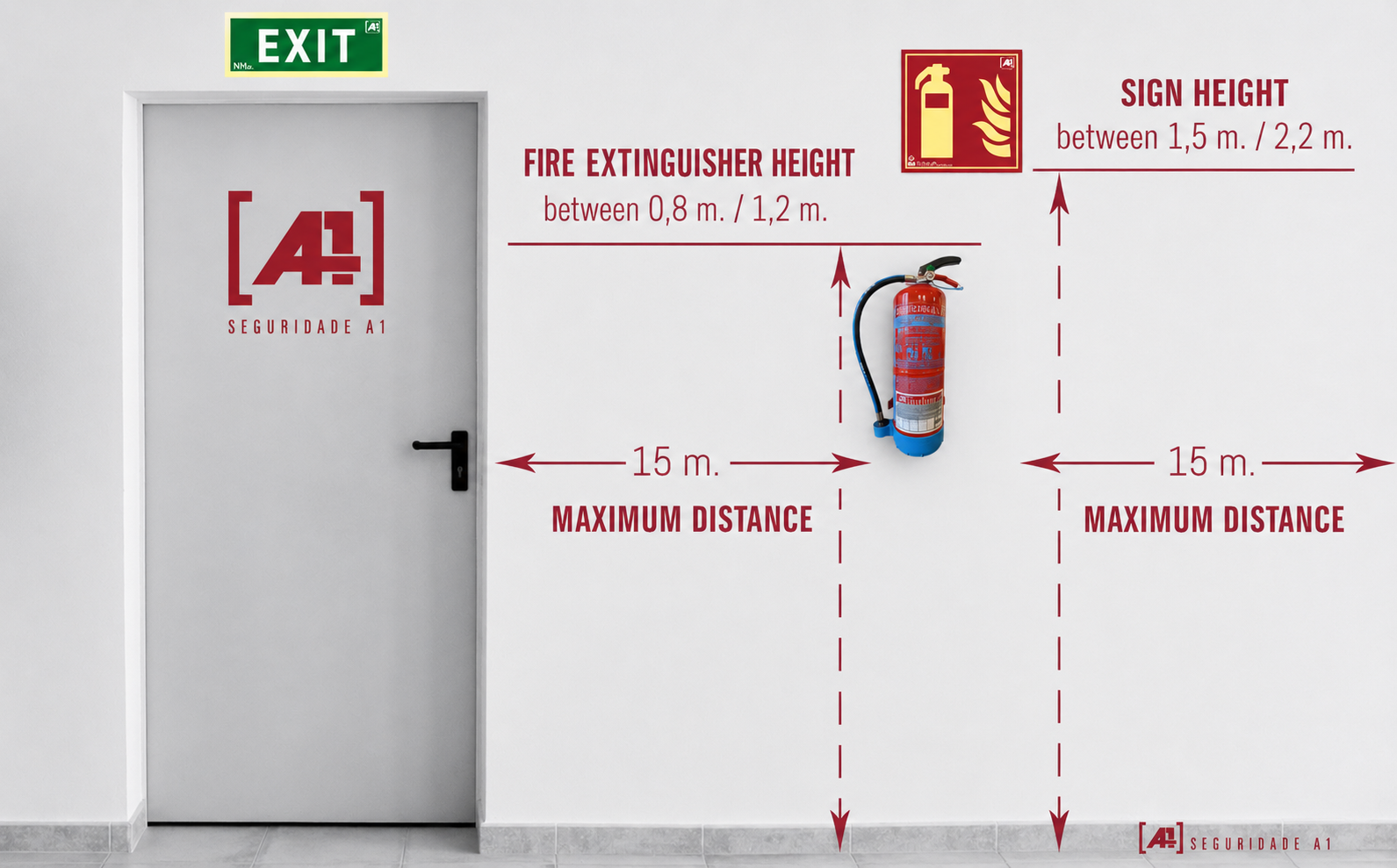
- The maximum distance to a fire extinguisher must not exceed 15 metres along evacuation routes.
- In areas considered to be high-risk, it may be necessary to install a fire extinguisher every 10 metres.
This means that simply “having a fire extinguisher” is not enough.
It must be properly distributed throughout the premises so that it can be used quickly in the event of an emergency.
Does a Small Premises Also Need a Fire Extinguisher?
In many cases, yes.
As a general rule, premises larger than 100 m² must have at least one portable fire extinguisher.
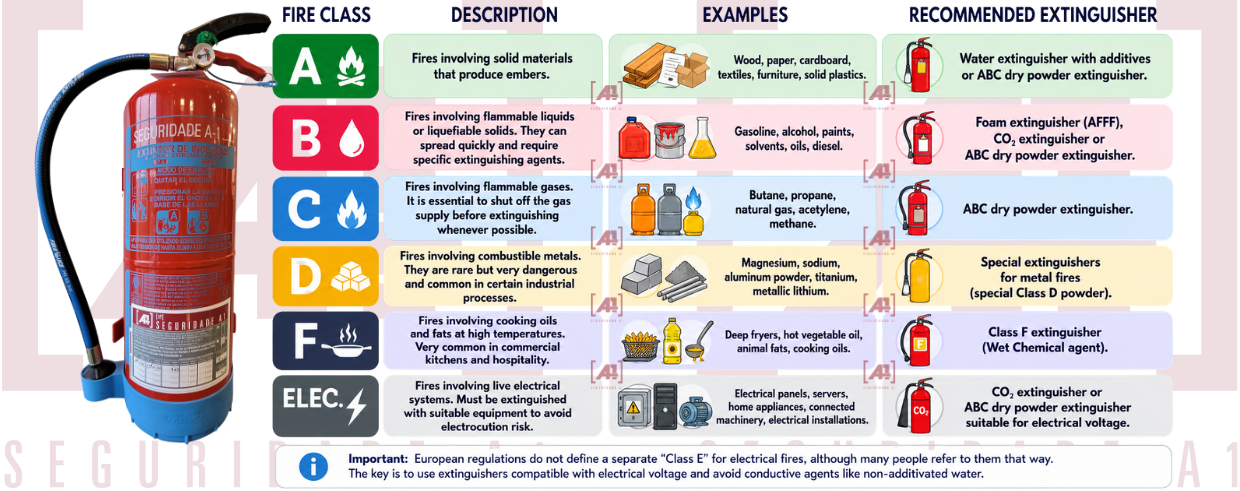
The most common option is to install ABC powder fire extinguishers with a 21A/113B rating, as they are suitable for dealing with:
- Solid combustible materials.
- Flammable liquids.
- Certain electrical hazards.
The letters indicate the type of fuel that a fire extinguisher can be used to extinguish: A for solid combustible materials, B for flammable liquids, and so on.
The numbers indicate the size of fire that the extinguisher is capable of handling; the higher the number, the greater its extinguishing capacity.
The CE marking guarantees that the fire extinguisher has been manufactured in accordance with the requirements of the Pressure Equipment Regulation.
However, not all businesses require exactly the same fire extinguishing system.
What Type of Fire Extinguisher Do I Need?
This is another common mistake: assuming that all fire extinguishers are suitable for every type of fire.
Each extinguishing agent is designed for specific classes of fire.
Depending on the activity carried out, it may be necessary to use:
- Powder fire extinguishers.
- CO₂ fire extinguishers.
- Foam fire extinguishers.
- Water-based fire extinguishers with additives.
For example:
- CO₂ fire extinguishers are commonly recommended for electrical panels and electrical equipment.
- Meanwhile, many commercial premises use ABC powder fire extinguishers.
Activities with a Higher Risk of Fire
Some activities require more specific fire protection measures:
- Tourist accommodation facilities.
- Public entertainment venues.
- Recreational activities.
- Industrial facilities.
- Parking garages.
- Healthcare facilities.
- Refrigeration plants and facilities.
- Petroleum installations.
- Or premises used for storing flammable materials.
In these cases, fire protection measures should be assessed and designed on a case-by-case basis.
Where Should Fire Extinguishers Be Installed?
Their placement is also regulated.
Fire extinguishers must:
- Be clearly visible.
- Be easily accessible.
- Be installed in areas close to evacuation routes.
In addition:
- They must be installed at an approximate height of between 80 cm and 120 cm from the floor.
- They must be properly signposted in accordance with UNE standards.
One of the most common issues identified during inspections is finding fire extinguishers that are:
- Hidden.
- Obstructed.
- Not properly signposted.
- Installed in locations that are difficult to access.
And that can turn an otherwise valid piece of equipment into a useless system during an emergency.
Is It Mandatory to Inspect Fire Extinguishers?
Yes. And this is one of the most important aspects.
A fire extinguisher that is not properly maintained may fail to operate when it is actually needed.
According to the RIPCI:
- A basic visual inspection must be carried out every three months.
- Once a year, an inspection must be performed by an authorised fire protection company.
- Every five years, the extinguisher must undergo hydraulic pressure testing (retesting).
What Is Hydraulic Pressure Testing (Retesting)?
Hydraulic pressure testing, commonly known as retesting, is a mandatory procedure used to verify:
- The internal condition of the fire extinguisher.
- The strength and integrity of the cylinder.
- Its safe operating condition.
In addition, fire extinguishers have a maximum service life of 20 years.
What Should Be Checked During Quarterly Inspections?
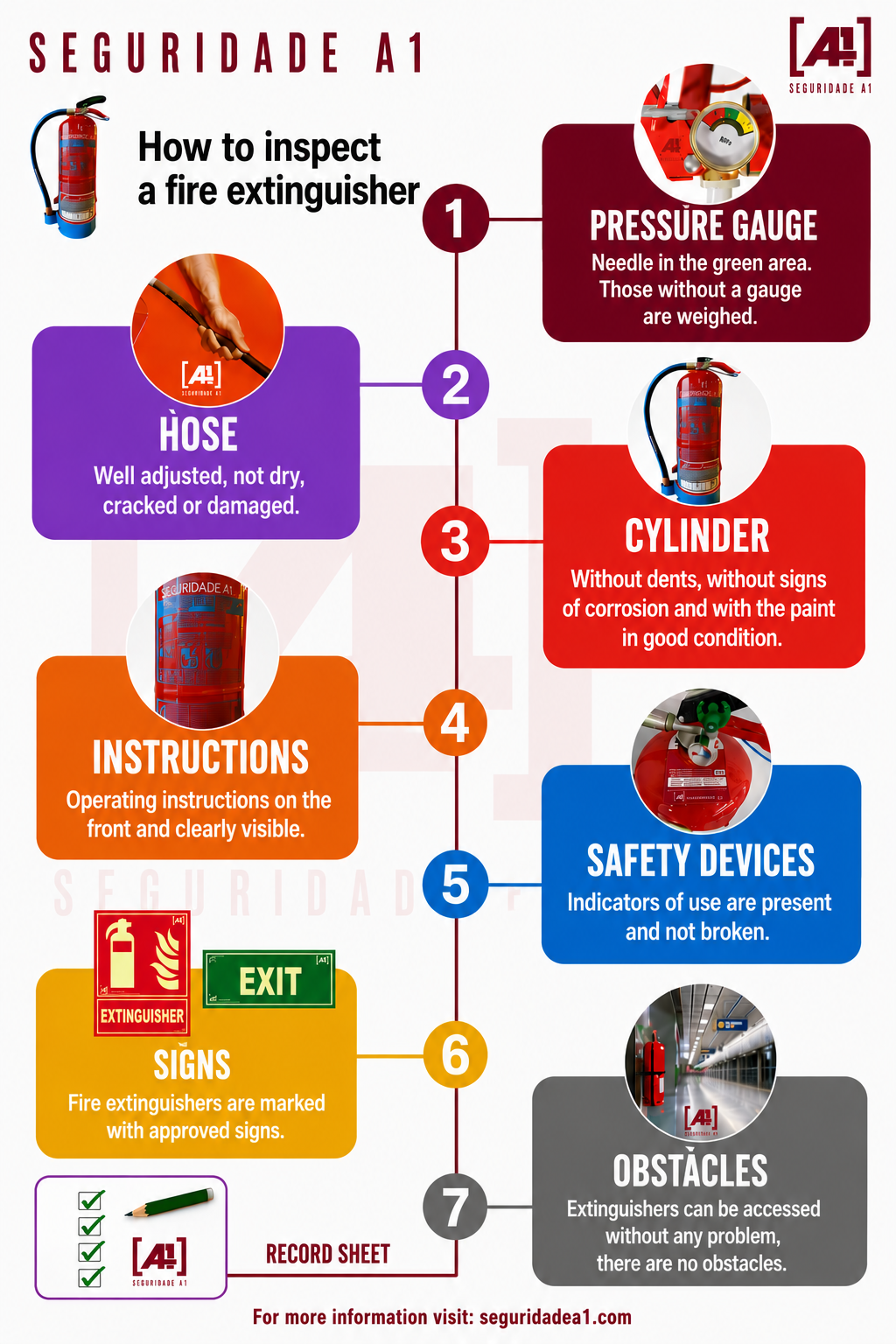
Among other things, the following should be verified:
- That the fire extinguisher is in its designated location.
- That it is clearly visible and easily accessible.
- That the pressure gauge is within the correct operating range.
- That it shows no signs of impact damage or deterioration.
- That the hose is in perfect condition.
- That the safety seals are intact.
- That it has not been partially or fully discharged.
These inspections must be properly documented and recorded.
What Happens If You Do Not Comply with the Regulations?
Many businesses only pay attention to fire extinguishers when:
- An inspection takes place.
- They need a licence.
- Or an incident occurs.
However, failing to comply with fire safety regulations can result in:
- Fines and penalties.
- Problems with insurance coverage.
- Difficulties when opening or operating the business.
- Civil liability.
- Serious risks to people and property.
And most importantly: a small fire can become a very serious problem within minutes if there are no immediate means of intervention available.
Every Premises Requires a Different Solution
The same level of protection is not required for:
- A small retail store.
- A café.
- An industrial warehouse.
- An office.
- Or a workshop.
For this reason, it is advisable to have an authorised fire protection company carry out a professional assessment to determine:
- How many fire extinguishers you need.
- What type of extinguishers are required.
- Where they should be installed.
- And what other fire protection measures may be necessary.
Current Reference Regulations
- Applicable municipal regulations and local ordinances.
- Technical Building Code (CTE) – Basic Fire Safety Document (DB-SI).
- Fire Safety Regulation for Industrial Establishments (RSCIEI).
- Fire Protection Systems Regulation (RIPCI) – Royal Decree 513/2017.
RIPCI: Fire Protection Systems Regulation.

Royal Decree 513/2017, which approves the Fire Protection Systems Regulation (RIPCI), is the legislation that governs in Spain the design, installation, commissioning, maintenance, and inspection of active fire protection systems and equipment.

The consolidated text currently incorporates the 22 amendments introduced by Royal Decree 164/2025, which came into force on 10 May 2025. Among the main changes are the new exemption from the ten-year inspection requirement in certain cases, the possibility for users to install fire extinguishers in premises of up to 100 m², and the complete update of Annex II, relating to maintenance operations, as well as the appendix containing the applicable UNE standards.
Important Note on Updated Regulations
- Some requirements may vary depending on the autonomous community, the type of activity, and the use of the premises.
- The RSCIEI has been updated in recent years in certain technical aspects.
- Local authorities may introduce additional requirements as part of activity licence applications.
For this reason, particularly in the case of renovations, new business openings, or changes of activity, it is advisable to request an up-to-date professional assessment.
At SEGURIDADE A1, We Help You Comply with Regulations and Protect Your Business
At SEGURIDADE A1, we design and maintain fire protection systems tailored to the real needs of each facility.
We help you to:
- Comply with current regulations.
- Choose the right equipment.
- Carry out the required inspections and maintenance checks.
- And ensure that your business is genuinely protected.
You can also rely on us for the preparation, implementation, and ongoing management of emergency plans. In addition, we help ensure compliance through emergency drills and staff training programmes.
Because prevention is not just about avoiding penalties.
It is about taking action before a problem arises.
📞📧 Contact us with no obligation; we will be happy to assist you.
🔐 At SEGURIDADE A1 we help you design tailored protection so you can live and work with complete peace of mind.
Remember that we are security specialists, that our 24-hour Alarm Receiving Center is located in Santiago de Compostela, and we have offices in Madrid and Alicante, but we provide security systems and services throughout Galicia, all of Spain, and part of abroad.
Comprehensive security in Galicia, Asturias, Cantabria, Basque Country (Euskadi), Navarra, La Rioja, Aragón, Catalonia, Valencian Community, Andalusia, Extremadura, Madrid, Castilla-La Mancha, and Castilla y León.
If you found this content interesting, you may also be interested in:
How to Use a Fire Extinguisher? 5 simple Steps.
Security grades in private alarms in Spain: a complete guide to choosing the best alarm for your home or business.
How to secure your home? 10 Home Security Tips that really work.
How does a temperature control system for data servers and cold chain work?
¿Cómo blindar un ayuntamiento frente a la delincuencia? Soluciones reales de seguridad ciudadana
